34+
Years of Experience
40%+
Fortune 100 clients
60k+
Students Trained
7
SPCTs, incl. 2 SAFe Fellows
Two delivery systems, one organization
Many enterprises run Agile Release Trains for enhancements and BAU work while large initiatives still go through annual budgets, business cases, project charters, and stage-gate governance. Each system works on its own terms. Together they create hand-offs, competing priorities, and no single view of value.
Add AI, which changes how work is done in both systems, and the gap widens.
What we help you decide
- Whether to organize around value streams
- How business and technology teams align inside them
- How large strategic initiatives run in the future model
- Whether project funding moves to value stream funding
- How governance, portfolio management, planning, and prioritization change
- How Agile and traditional delivery coexist during the transition
- Which leadership and cultural changes the transition needs
How an engagement runs
1. Assess and align
- Current operating model, Agile maturity, delivery performance, funding, and workforce
- The split between BAU Agile delivery and project-based delivery
- Executive alignment on the case for change, outcomes, and decision principles
- AI, data, risk, and change-readiness considerations
2. Design the future state
- AI-enabled value streams, roles, decision rights, funding, and measures
- How strategic initiatives, BAU, small change, and shared services fit
- Which capabilities to build, hire, source, or augment with AI
- A roadmap grounded in your constraints
3. Mobilize and implement
- Transformation structure and measures of success
- Select and launch the first value streams and AI-Native ARTs
- Embedded practitioners working alongside your leaders
- Pilots of prioritized AI-enabled workflows
4. Scale and embed
- Apply what the first value streams taught us
- Expand to more value streams and business areas
- Embed portfolio, funding, governance, and AI practices
- Measures for business value, adoption, and delivery performance
5. Transition to ownership
- Transfer playbooks, tools, and methods
- Develop internal coaches, product leaders, value stream leaders, and AI champions
- Written readiness criteria for each responsibility
- A structured handover so you can run and improve the model
Who does what, phase by phase
We plan our exit from day one. Accountability moves to your people as they show they can carry it.
| Phase | ICON leads | Jointly delivered | You own |
|---|---|---|---|
| Assess and align | Assessment method, interviews, maturity and flow analysis | Executive alignment sessions, case for change | Sponsorship, access to people and data, decisions |
| Design the future state | Operating model options, value stream identification workshops | Value stream and role design, funding and governance model | Design decisions and approval |
| Mobilize and implement | ART launch preparation, coaching of the first value streams | Team formation, backlog changes, AI workflow pilots | Staffing the value streams, removing blockers |
| Scale and embed | Coach-the-Coach, measurement design | Expansion to new value streams, governance activation | Running the operating model day to day |
| Transition to ownership | Readiness assessments against agreed criteria | Handover of playbooks and tools | Coaching, training, and continuous improvement |
Capability transfer starts in week one
- We pair each ICON practitioner with a named counterpart on your side.
- Coaching, shadowing, supervised practice, then delegation.
- Train-the-Trainer and Coach-the-Coach build the internal coaches who keep the change going.
- Internal coaches and trainers certified through the AI-Native SAFe path, including AI-Native Trainer and SAFe Advanced SPC.
- Communities of practice and a LACE that outlast the engagement.
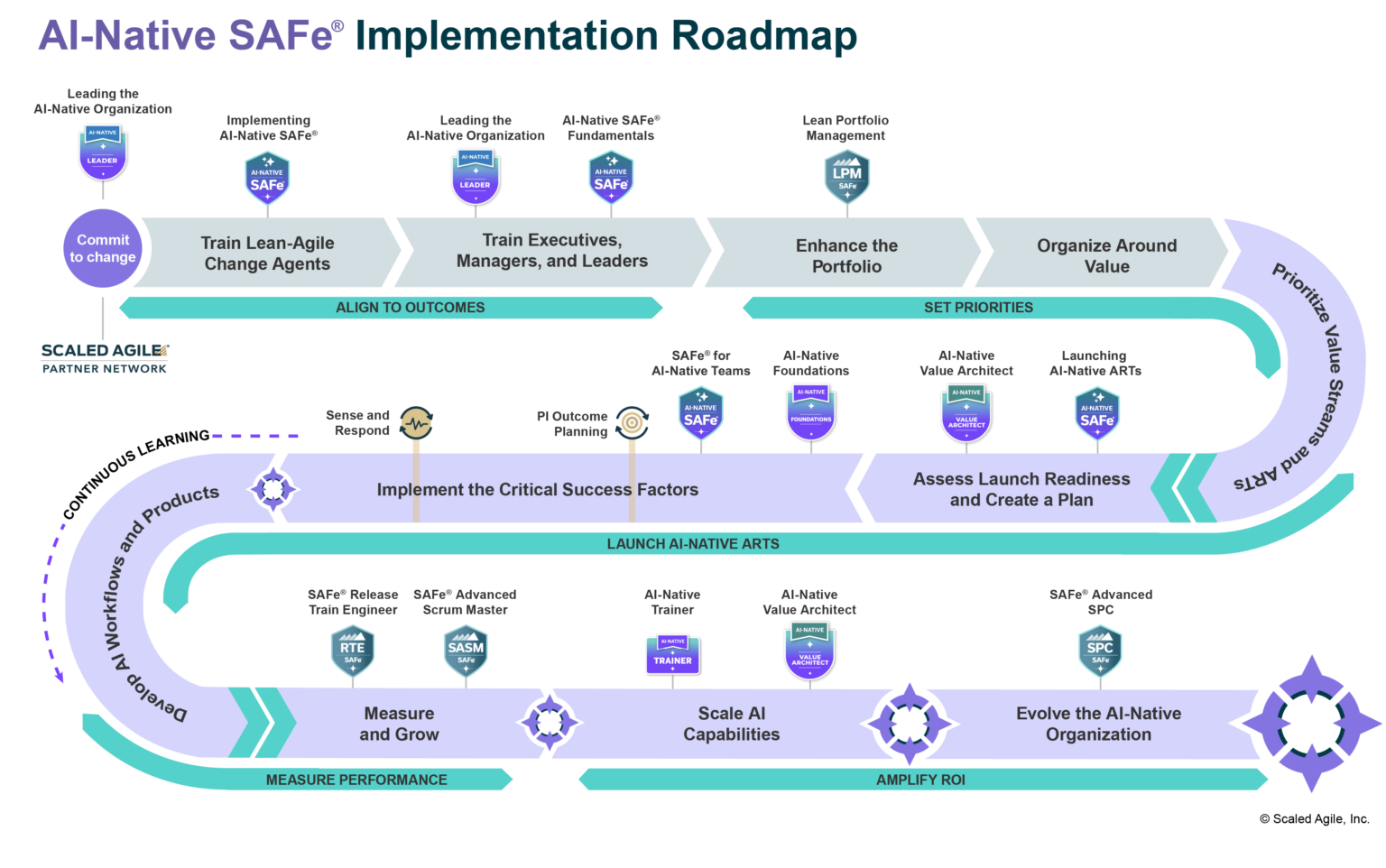
Built on the AI-Native SAFe® Implementation Roadmap
The team we bring
ICON Agility Services, a Platinum SPCT Scaled Agile Partner, staffs each engagement with practitioners from across these disciplines.
- Executive transformation leadership from our SPCTs
- Operating model and value stream design
- Lean Portfolio Management and funding
- Product and delivery coaches for RTEs, Scrum Masters, and Product Owners
- AI operating model and workflow coaches
- Organizational change management
- Training and capability building
Operating model work in regulated industries
Enterprise Transformation & Portfolio Alignment
24 portfolios aligned under a unified operating model.
Read the case studyInsurance Claims Modernization & CX
A national carrier processed claims 35% faster while strengthening compliance.
Read the case studyAlready invested in PPM and APM tools? We connect the operating model to the tools you have. See SAFe LPM with PPM tools
Frequently Asked Questions
No. We stay through mobilization, implementation, and scaling, and we plan our own exit from the start. Each phase spells out what ICON leads, what we do jointly with your teams, and what you own.
Usually, but not all at once. Most organizations run project and value stream funding side by side for a period, move work as value streams prove they can deliver, and keep a lightweight path for initiatives that truly need project treatment. The assessment phase tells us which path fits.
For a while, yes, and we design for it. The goal is one portfolio view and one set of priorities, even if some work still runs through traditional governance during the transition.
We pair each ICON practitioner with a named counterpart. We use coaching, shadowing, supervised practice, and progressive delegation, with written readiness criteria for each responsibility we hand over. Train-the-Trainer and Coach-the-Coach build the internal coaches and trainers who keep it going.
No. We work within your enterprise AI strategy, architecture, data strategy, and responsible AI governance. Our focus is the operating model: how value streams, teams, roles, funding, and governance change when AI does part of the work.