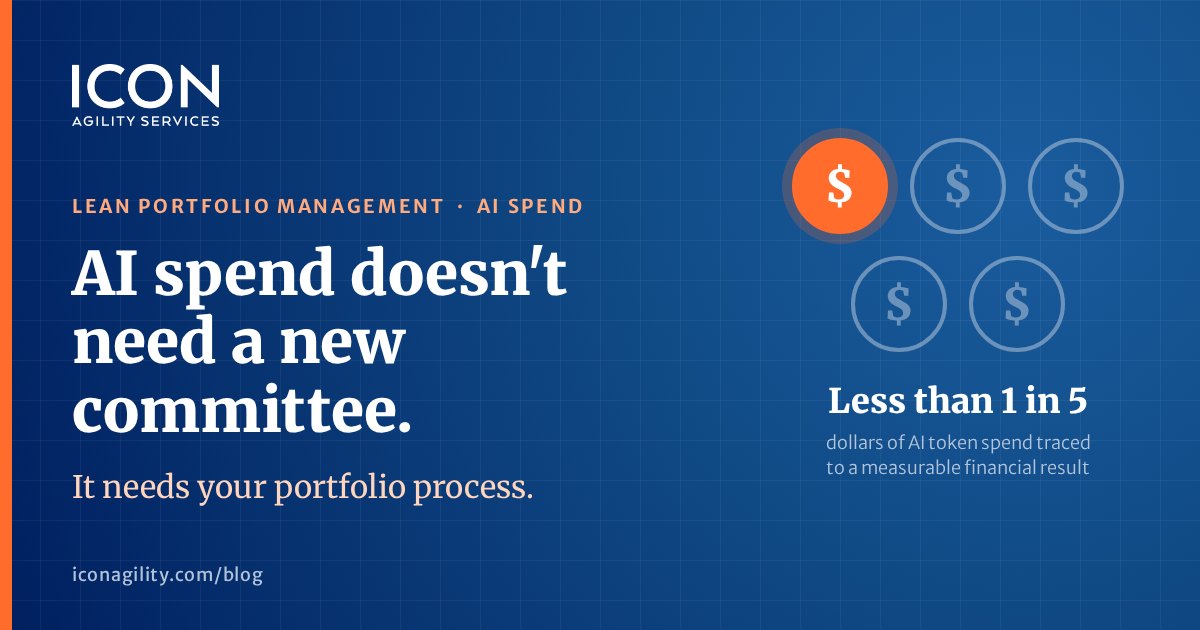
Accenture surveyed 750 senior executives and found that less than one dollar in five of enterprise AI token spend can be traced to a quantified financial outcome. The other four dollars are funding something. Most enterprises can't say what.
The usual reaction is to stand up an AI governance board, with a new charter, a new intake template and a new monthly meeting. We think that's the wrong move. This post lays out why, and what to do instead. Over the next four weeks we're also posting a short series on LinkedIn that takes each point one at a time. Follow ICON on LinkedIn if you'd like to argue with us in the comments.
AI got an exemption from the discipline you already have
Enterprises that practice Lean Portfolio Management (LPM) solved the "how do we stop weak investments" problem years ago. They fund value streams instead of projects. They set spending guardrails. They require every major initiative to state up front what result it expects and when. Then they review on a schedule, and some things get stopped.
AI spend has mostly skipped that process. Often the same leaders who would never let a $5M ERP upgrade go ahead without a business case have approved AI pilots on enthusiasm and a slide deck.
That's the gap. You don't need another committee. You need to end the exemption, so AI comes through the same front door as everything else.
The first question for 2027 planning, then: is AI going through your portfolio process, or around it?
Three stop rules that already work
The hardest question in AI spending is how to stop something. Good portfolio practice answers it with three pieces.
1. A hypothesis agreed before funding
Before money moves, write down what the initiative should change, how you'll measure it, and which leading indicator you expect to see first. In SAFe® this lives in the Epic hypothesis statement and the Lean business case. A made-up example: "An AI intake assistant will cut claims intake time from four days to two. We'll see it first in the share of claims routed without a manual touch."
2. A minimum viable test with a date
Fund the smallest test that can prove or disprove the hypothesis, and put a date on it. On that date the portfolio decides to keep going, change direction or stop. Treat a stop as a successful outcome. You learned something cheaply, and the money goes back into the pool for the next idea.
3. Budgets set by value stream and revisited on a fixed cadence
When budgets belong to value streams and get revisited on a regular cadence, moving money is routine. Nobody has to win a political fight to pull funding from a stalled AI pilot and give it to one that's working.
None of this was invented for AI. All of it applies to AI. If your portfolio already runs this way for everything except AI, you're closer than you think. If it doesn't run this way for anything, AI is about to make that very visible.
Delivery got faster. Decisions didn't.
In Atlassian's State of Product 2027 report, 69% of product leaders say more effort has gone into shipping faster while decision-making hasn't sped up, even with AI. Teams build faster, and then the work sits in the same queue waiting for the same quarterly approval forum.
That makes the portfolio the constraint, so that's where the attention belongs. Three changes help:
- Limit work in flight at the portfolio level. Fewer epics in progress means each one reaches a decision sooner. A Portfolio Kanban with explicit WIP limits makes the queue visible to everyone.
- Match funding cadence to delivery cadence. If your teams ship in two-week iterations and funding is reviewed quarterly, a team can run six iterations before anyone decides whether the work should continue.
- Push decisions down, within guardrails. Let the people closest to the evidence make keep-going or stop calls inside agreed spending limits. Escalate only what falls outside them.
When did your enterprise last change its portfolio funding cadence? If the answer is "before AI showed up in delivery," that's probably where your decisions are getting stuck.
Cost is visible now. Stopping isn't.
Every major platform vendor can now show you what your AI costs: tokens by team, spend by initiative, trend lines on a dashboard. That's useful. It isn't a decision.
A dashboard showing an initiative with no return won't stop that initiative. A portfolio with clear decision rights, guardrails and a review cadence will. That's the unglamorous core of Lean Portfolio Management, and it's exactly what goes missing when AI is funded as a string of one-off pilots.
Most enterprises bought the instrument panel and skipped the brakes.
Five questions to bring to 2027 planning
- Does every significant AI initiative have a written hypothesis and a leading indicator?
- Does each one have a test date, and do you know who makes the call on that date?
- Has your portfolio stopped an AI initiative in the last 12 months? If not, is that because they're all working?
- Does AI spend sit inside value stream budgets, or in a separate pot?
- How long do teams wait between "we have evidence" and "we have a funding decision"?
If two or more of those answers made you wince, you're in good company. You can fix it without a new committee.
Where ICON comes in
ICON Agility Services has spent years inside enterprise portfolios, setting up the decision rights, guardrails and review cadence that make Lean Portfolio Management work. As the leading Platinum SPCT Scaled Agile Partner, we help you bring AI spend into the portfolio process you already have instead of building a parallel one.
Tell us what's getting in the way. Talk to an LPM coach, read about our Lean Portfolio Management consulting, or take the free Agile Maturity Scorecard to see where your portfolio stands today.